For many years, conversations about responsible consumption have been directed mainly at individuals. We have been encouraged to avoid unnecessary purchases, reduce waste, reuse what we can and recycle what remains.
These habits matter. But they address only one part of a much larger challenge.
The more important question for businesses is this: how are we designing, producing, distributing and recovering the things people consume in the first place?
As economies grow and consumption rises, sustainability can no longer be framed solely as a matter of individual behaviour. Businesses are increasingly expected to consider the resources, materials, energy, labour, logistics and systems behind every product or service they place in the market.
In India, this shift is becoming more visible through discussions around resource efficiency, circularity, Extended Producer Responsibility, responsible business conduct, sustainable supply chains and climate-conscious growth. The focus is gradually moving beyond asking consumers to make better choices and towards asking businesses to create choices that are genuinely better by design.
This does not mean companies should simply encourage people to buy less. It means they must think more deeply about the value they create, the resources they use and the consequences that remain long after a transaction is complete.
From Selling More to Creating More Value
Traditional business models have often been built on increasing production, expanding market reach and encouraging repeat purchases. Growth remains essential to business and economic development. The question is whether growth must always depend on using more virgin resources, producing more waste and shortening product lifecycles.
A more resilient model is one that creates greater value from the resources already in use.
That may involve designing products that last longer, can be repaired, upgraded, refurbished, shared, recovered or recycled. It may involve reducing unnecessary packaging, improving manufacturing efficiency, using recycled inputs or developing service-based models that deliver outcomes without requiring customers to own more products.
This is not simply an environmental aspiration. It is a commercial opportunity.
A durable product can strengthen customer trust and brand reputation. A repair or refurbishment programme can create an ongoing customer relationship. Material efficiency can lower costs. Better inventory planning can reduce waste. More robust resource management can improve business resilience when commodity prices rise or supply chains face disruption.
For example, a manufacturer that designs equipment for easier servicing may reduce warranty claims, extend product life, create aftermarket revenue and improve customer loyalty—all while reducing material waste.
Responsible consumption, therefore, does not sit outside commercial thinking. Done well, it becomes part of how a company builds efficiency, trust, innovation and long-term competitiveness.
The Product Does Not Begin at the Store
Consumption is often difficult to assess responsibly because consumers usually see only the final product.
A product on a shelf may represent raw-material extraction, processing, energy use, manufacturing, packaging, shipping, warehousing, retail infrastructure and last-mile delivery before it reaches the customer. At the end of its useful life, it may also create further demands through collection, disposal, recycling or recovery.
The purchase is only the visible point in a much larger system.
My experience in maritime operations and engineering systems has consistently reinforced this perspective. Moving a product from one part of the world to another requires an extensive network of vessels, ports, terminals, trucks, warehouses, energy systems and skilled people. The consumer sees the finished product; the infrastructure, fuel, emissions and operational effort behind it are far less visible.
This is why responsible consumption cannot be separated from responsible production.
Every purchase creates demand. But every product also reflects hundreds—and sometimes thousands—of decisions made before it reaches the customer: decisions about material selection, supplier standards, manufacturing processes, transport routes, packaging design and product durability.
The question for business leaders is not simply whether a product can be sold. It is whether it has been designed and delivered in a way that creates value without imposing avoidable costs on society, the environment or future generations.
Leadership and Board Accountability
Responsible consumption becomes a leadership issue when it is treated not as a communications theme, but as a strategic and operational consideration.
Senior leaders and boards should ask questions that go beyond quarterly sales, unit volumes and production targets:
– Are we using materials, water and energy efficiently?
– Have we designed our products for durability, repairability and safe recovery?
– Which materials can be reduced, substituted, reused or recycled?
– Where does waste arise across our value chain, and what does it cost us?
– Are we exposed to supply, price or regulatory risks because of resource dependence?
– Can product, procurement or logistics decisions improve both margins and environmental outcomes?
– Do we have credible data to measure progress rather than relying on broad sustainability claims?
These questions do not need to be isolated within a sustainability report or delegated entirely to a specialised team. They can be embedded in product development, procurement, operations, capital allocation, innovation, risk management and corporate strategy.
The objective is not to introduce complexity for its own sake. It is to make better decisions with a longer time horizon.
For boards, this also means ensuring that management has the right incentives, data and governance mechanisms to identify resource-related risks and opportunities early. A business that understands its material flows, lifecycle costs and end-of-life responsibilities is likely to be better prepared for regulation, customer expectations and supply-chain volatility.
Consumers Cannot Carry the Responsibility Alone
There is a clear limit to how much responsibility can reasonably be placed on consumers.
People can make more informed choices, but those choices are shaped by price, availability, convenience, product information and the infrastructure around them. A product that is genuinely more sustainable but significantly more expensive, hard to repair or difficult to access will not automatically become the mainstream choice.
This creates a shared responsibility.
Businesses can design better products, services and business models. Governments can establish clear policy signals, collection systems, standards and recycling infrastructure. Consumers can make more thoughtful purchasing decisions. Technology can improve traceability, transparency, product efficiency and recovery systems.
The strongest outcomes will come when these different parts of the system work together.
For instance, recycling targets alone cannot solve a waste problem if products are not designed to be disassembled, collection systems are weak or recovered materials have no reliable market. Equally, product innovation will have limited impact if customers cannot access repair services or do not receive clear information about durability, maintenance and disposal.
Responsible consumption requires a system that makes the better choice the practical choice.
Beyond the Next Purchase
Perhaps the most useful shift is to stop viewing consumption only as a moment of purchase.
Before buying something, individuals can ask whether they genuinely need it and whether it will offer lasting value. Businesses can ask how much resource is required to produce it, how efficiently it can be delivered and whether it has been designed for a useful life beyond a single transaction. Designers can consider durability and repairability. Manufacturers can plan for resource recovery. Policymakers can consider what happens once the product reaches the end of its usable life.
These questions may appear simple. Collectively, however, they can reshape how value is created, delivered and retained.
Responsible consumption is not about stopping economic growth or asking people to stop buying things. It is about making growth more thoughtful, efficient, resilient and durable.
The next phase of sustainability may depend less on how effectively we communicate the message of “consume responsibly” and more on how effectively we build systems that make responsible choices accessible, affordable and practical.
The real opportunity is not simply to consume less.
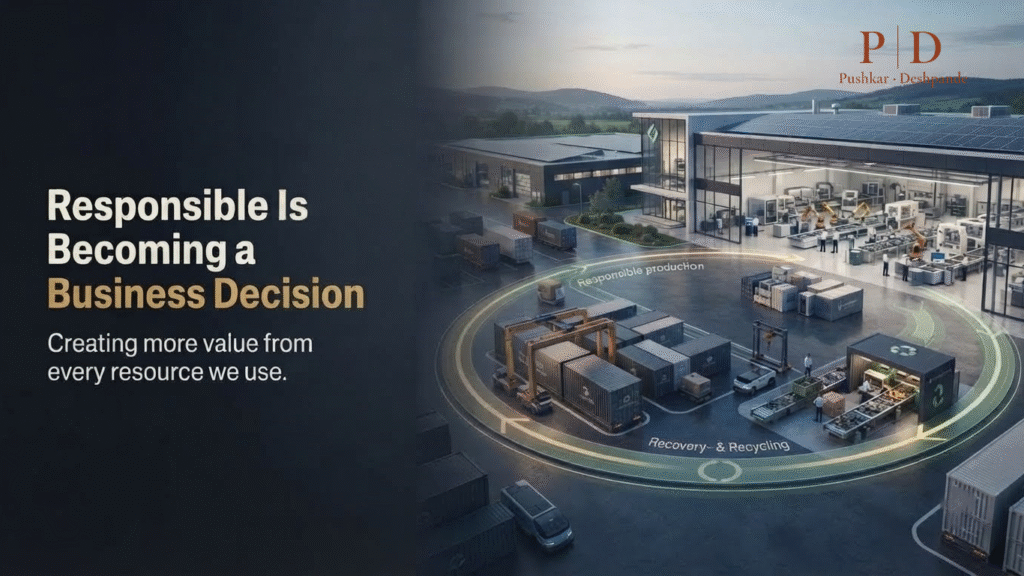
It is to create more value from every resource we use.