
By Pushkar Deshpande, Independent Director | Start-up Mentor | Strategic Advisor
Global enterprises increasingly face a complex operational challenge: maintaining business continuity while engaging with supply chain partners whose processes, standards, and cultural frameworks diverge significantly from their own. This phenomenon—termed operational incongruence—presents risks that extend beyond simple non-compliance, requiring sophisticated risk mitigation strategies that balance commercial necessity against operational integrity.
The Reality of Asymmetric Partnership Dynamics
Not all organizations possess equivalent leverage when selecting vendors and service providers. While industry leaders may mandate strict adherence to their safety, sustainability, and operational protocols, mid-tier companies often lack the financial clout, market influence, or supplier alternatives to enforce such requirements. The challenge intensifies when “different” does not necessarily mean “substandard”—two operationally competent organizations may simply approach problem-solving through incompatible frameworks that must somehow interface to produce desired outcomes.
Third-party risk management literature confirms that organizational dependencies on external entities create direct operational vulnerabilities, making robust risk identification and mitigation essential to operational resilience. The maritime industry exemplifies this challenge regularly, where vessels encounter port terminals with safety regulations and operational procedures substantially different from shipboard practices. While adapting to higher standards proves manageable, accommodating lower or simply divergent standards introduces complexity and risk exposure disproportionate to the business value at stake.
Scaling the Challenge: From Multicultural Teams to Critical Operations
Consider first the microcosm of multinational teams, where language barriers, cultural differences, educational backgrounds, and skill variations could theoretically impede productivity. Successful organizations mitigate these differences through systematic controls: establishing common working languages, implementing standardized safety training, requiring certified competency levels, and creating clear communication protocols. These foundational practices demonstrate that operational incongruence at team level can be managed through deliberate process architecture.
The challenge escalates dramatically when operations involve vendors in developing markets where safety culture, regulatory oversight, and technical competency differ fundamentally from parent company standards. In such scenarios—particularly in remote locations with monopolistic local suppliers and limited recourse—organizations face environments where personal safety concepts, command hierarchies, and communication channels may be virtually absent. The parent company confronts not merely operational differences but potentially chaotic operational environments where ad-hoc decision-making replaces structured process management.
Risk Mitigation in Uncharted Operational Territory
When precedent data does not exist to forecast consequence scales, traditional risk assessment frameworks prove inadequate. A phased, incrementally escalating approach becomes necessary
—identifying and addressing risks sequentially rather than attempting comprehensive upfront mitigation. This methodology requires significant organizational resilience: the capability to advance operations while simultaneously maintaining readiness to halt or reverse course when predetermined risk thresholds are breached.
Critical to this approach is recognizing that local vendors, despite enthusiasm and commitment, may have secured contracts beyond their technical capacity or training. Operating under “trial and error” principles in high-stakes environments creates cascading liability exposure, particularly in jurisdictions where political and legal frameworks favor domestic entities. Documentation and process formalization become essential—not merely for operational execution but for legal protection should incidents occur.
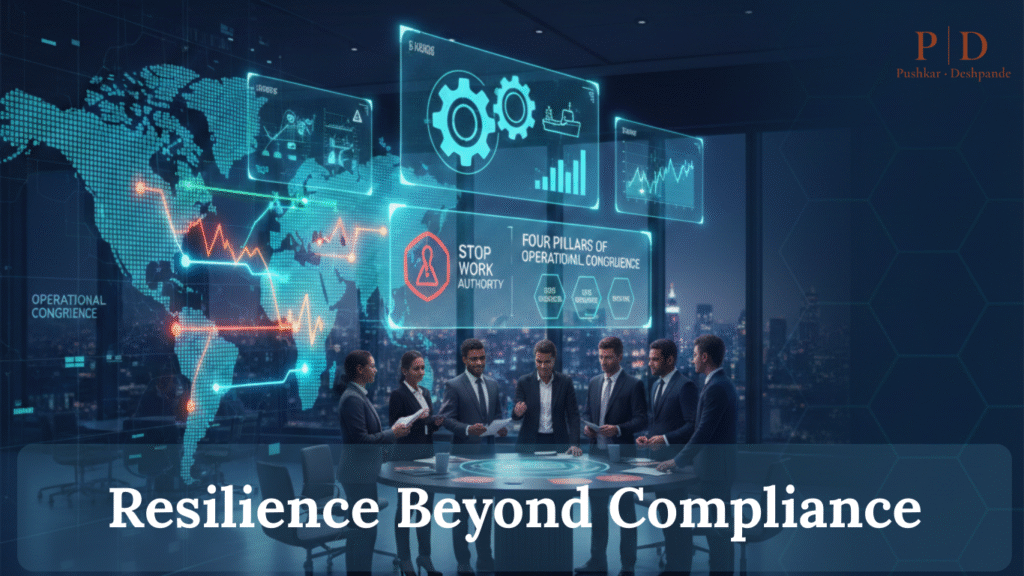
The Framework: Four Pillars of Operational Congruence
Organizations navigating incompatible system integration should establish four fundamental safeguards that transcend industry-specific variables:
Operational Resilience: The organizational capacity to adapt rapidly to fluid situations, recalibrating expectations and priorities while preserving strategic objectives. This requires distinguishing between negotiable operational details and non-negotiable outcomes, building flexibility into process architecture rather than rigid adherence to predetermined procedures.
Empowered Oversight: Deploying authoritative representatives with decision-making autonomy to manage high-consequence scenarios in real-time. Multiple observers positioned at different operational stations provide redundant situational awareness while ensuring no single point of failure in hazard recognition.
Defined Risk Boundaries: Establishing quantified maximum acceptable consequences before operations commence. These thresholds—agreed upon at executive level—provide field personnel with clear criteria for operational continuation versus escalation or termination, removing ambiguity from critical decisions under pressure.
Stop Work Authority: Institutionalizing the principle that on-site officers possess unconditional authority to halt operations when risk boundaries approach or breach. This protocol eliminates pressure to continue unsafe work while protecting both personnel safety and organizational liability.
Strategic Implications for Modern Enterprises
As global supply chains grow increasingly interdependent, operational incongruence will intensify rather than diminish. Organizations must evolve from viewing vendor compliance as binary (compliant/non-compliant) toward more nuanced frameworks that accommodate process diversity while maintaining outcome integrity. This requires investment in adaptive systems, empowered field personnel, and robust contingency planning that recognizes third-party failure as an operational reality requiring systematic preparation.
The maritime sector’s experience managing port-to-ship interface challenges offers transferable lessons: anticipate incongruence as inevitable, establish clear communication protocols, invest in real-time monitoring capabilities, and maintain alternative vendor relationships even when monopolistic conditions appear permanent. Operational resilience emerges not from eliminating risk but from building organizational capacity to absorb, adapt to, and recover from third-party disruptions.
What additional frameworks have proven effective in your experience managing operationally incompatible partnerships? Share your insights on building resilience into complex, multinational supply chain operations.